


Company News
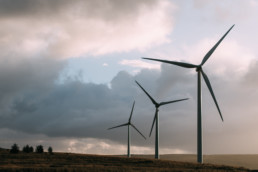
Vestas Extends its Reach into the Russian Market
The Danish company will set up its first blade production plant for wind turbines in Russia, after being signed the agreement on September 7th by Sergey Morozov, Sergey Nikolayevich Vasin, and Tommy Rahbek Nielsen, which are the Governor of the Ulyanovsk region, General director of the Ulyanovsk Region Development Corporation and Senior Vice President of Vestas, respectively.
According to Mr. Nielsen, “wind industry has a huge potential in Russia”, reported the business media Delovoye Obozrenie.
Vestas, which is considered the largest turbine producer all over the world, will invest around USD 24 million (RUB 1.4 billion) in the project, revealed the Kommersant. With this move the Danish firms intends to maximize the localization of components production, while obtaining the legal status of a Russian producer, giving the right to participate in public programs.
Acording to Tommy Rhabek Nielsen, Vestas will comply with the Russian policy of reaching a 65% level of localization or even more, provided that needed suppliers can be found on the Russian market.
The manufacture facilities will be located in the Zavolzhskiy district of Ulyanovsk. Its construction is expected to take place in the short term and will be completed by the middle of 2019. Vestas is expected to reach the production capacity of 300 blades yearly, that in turn will result in the creation of 200 new jobs.
Source. https://eurasianetwork.eu/2017/09/23/danish-vestas-will-build-its-first-blade-factory-in-russia/


Dutch Electric Trains Get 100% Powered by Wind Energy
According to the national railway company NS, its renewables goal had been met a year earlier than planned, since from the 1st of January, 100% of its trains are running on wind energy”.
Dutch electricity company Eneco won a tender offered by NS two years ago and the two companies signed a 10-year deal setting January 2018 as the date by which all NS trains should run on wind energy.
The fact that it is been an increase in the nomber of wind farms across the contry and off the coast of the Netherlands had helped achieve its aim a year earlier than planned.
This fact makes the Netherlands the first country in the world to have around 600,000 passengers daily that travel propelled by wind energy. Overall, the NS operates about 5,500 train trips a day.
So as to allow you to have an idea of what it is like, one windmill running for an hour is able to power a train for 120 miles, the companies said. However, they hope to reduce the energy used per passenger by a further 35% by 2020 compared with 2005.
Source. https://www.theguardian.com/world/2017/jan/10/dutch-trains-100-percent-wind-powered-ns
Amazon Texas project goes online
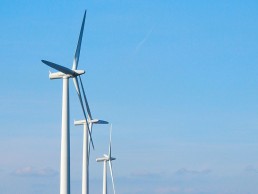
According to the internet giant, the 100-turbine Amazon Wind Farm Texas in Scurry County is the company’s 18th wind or solar project.
This project is owned and developed by Lincoln Clean Energy, and gathers 110 of GE’s turbines and provides US storage and information management services company Iron Mountain with 25.3MW of power, with the remainder going to Jeff Bezos’ firm.
The PPA would allow Amazon to achieve its long-term goal of powering its global infrastructure with 100% renewable energy, according to the firm.
The idea is that Amazon’s 227.7MW portion from the site will power one of its data centres for the company’s cloud computing arms.
Amazon's worldwide director of sustainability, Hara Hurst mentioned in an interview held in Texas that "Investing in renewable energy is a win-win-win-win — it’s right for our customers, our communities, our business, and our planet". In fact, they now have 18 wind and solar projects across the US with more than 35 projects to come.
Amazon also buys power from a 208MW project in North Carolina, 100.8MW site in Ohio and 150MW wind farm in Indiana, according to Windpower Intelligence, the research and data division of Windpower Monthly.
Source: http://www.windpowermonthly.com/article/1447901/amazon-texas-project-goes-online
The PCT and its role in the USA
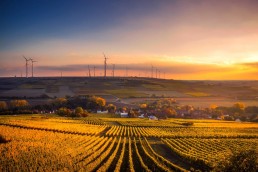
South Dakota is the State selected to install a 300MW wind project by Utility Xcel Energy, supported financially by a lower production tax credit (PTC).
Apel Clean Energy company has been developing the complex called Dakota Range I and II, which will be destined to be the first publically announced wind project to advance under the phase down of federal tax credits.
The project is expected to be fully completed by 2021 and Vestas will be the company chosen for installing these turbines.
Under the five-year phase-out of the support scheme, only projects that met the criteria by the end of 2016 would be eligible for the full $0.023/kWh.
Projects that begin construction this year, or have a certain amount of capital committed, will qualify for 80% of the full credit. This will decrease by a further 20 percentage points each year until 2020.
Source. http://www.windpowermonthly.com/article/1445858/xcel-energy-plans-300mw-lower-ptc-rate

Citigroup and Morgan Stanley go for Wind Energy
Citigroup, which is considered the largest financial service company in the world, and Morgan Standly, the New York-based financial bank, have recently made official their comittment to running 100 percent on wind and solar energy, as a way of standing up against U.S. energy policies.
Ever since the U.S. vowed to pull the U.S. out of the 2015 Paris Agreement, there's been a manifest escalade of corporate support from Standley and City, which aim for their operations to be carbon-neutral by 2022 and 2030, respectively.
Both banks also are joining RE100, an initiative that brings together more than 100 large companies that are working towards running on clean energy by signing deals to buy electricity from renewable-power generators. Other members include HSBC Holdings Plc, Bank of America corp, Swiss Re AG and Apple Inc, which reached 93 percent clean-energy use in 2015.
Nordex Generation Delta grows up to exceed 4MW
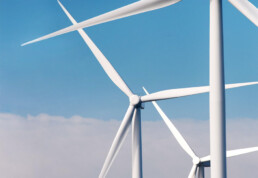
It is not unknown that wind turbines are being constantly enhanced to generate more and more MWs as a result of not only growing higher in the sky but also getting sturdier. In this way, Nordex is the last original equipment manufacturer (OEM) to join the 4MW VIP club, after successfully evolving its 3MW Delta series into a 4.0-4.5MW turbine with a 149-meter rotor.
The N149/4.0-4.5 first Delta 4000 model is to be presented at the Husum Wind 2017 in Germany on the 12th of Septemberfor low to medium wind speeds.
According to Nordex's head of product strategy Paris Lappas, a prototype is expected to come out in mid July, followed by several pre-series wind turbines and series production ramp up in 2019.
These are some of the benefits resulting from building these type of turbines:
- The N149/4.0-4.5 rotor-swept area in 4.0MW and 4.5MW power mode offer specific power ratings of 229W/m2 and 258W/m2, respectively.
- This model stands out against increasing competition in its capability to meet a wide range of site-specific requirements with a single hardware model.
- It is also designed to outlast the regular turbines for a 20-year operating lifetime, which can be extended to 25 years, depending on local turbine or site conditions and their associated loads spectrum.
- In developing the N149/4.0-4.5, Nordex creates multiple synergies between the Nordex and Acciona Windpower platforms, which will allow them to use a common supplier-base strategy, which commenced with selecting a single gearbox manufacturer for the N149/4.0-4.5.
To find out more about technical information please click on the following link http://www.windpowermonthly.com/article/1443226/nordex-generation-delta-grows-exceed-4mw.
The Renewables Revolution half a century ahead
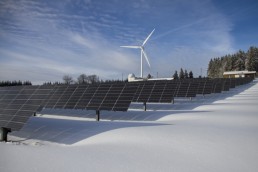
Researchers claim that up to 139 countries could use 100% renewables by 2050, containing hydro and solar power.
Wind market share would take up to 37,5% of the total being provided by onshore and offshore wind, accounting for 23.5% and 13,6%, respectively. According to the team estimations, 2.5 million 5mW turbines would require to be installed by mid-century, which would add up to 12,5 TW of capacity.
Indeed, this is really good news as the outcome is considered to be far more aggressive than what the Paris Agreement calls for. Despite the bumps that might come up along the road, researchers trully believe that the plans are still technically and economically feasible, which will require rapid electrification of the countries' respective energy sectors and consumers making individual changes, including changing to electric heat pumps for air and water heating, for instance.
Despite this might seem quite far, researchers' predictions are that 80% conversion to renewables will be achieved by 2030, with the final fifth over the next 20 years.
Among the social benefits are that this project will serve as a equializer for 1.5C global warming above pre-industrial levels, and therefore will help prevent millions of annual air-pollution deaths. Besides, these roadmaps provide the first specific plans ever produced to avoid 1,5 degrees Celsius global warming.
In addition to social benefits, such a transition will also generate over 20 million more permanent full-time jobs than lost worldwide, save consumer money and avoid over 3% of each country's GDP in air pollution health cost alone.
Source. http://www.windpowermonthly.com/article/1442852/139-countries-use-100-renewables-researchers-claim
Four dutch airports to be powered by renewable energy from 2018
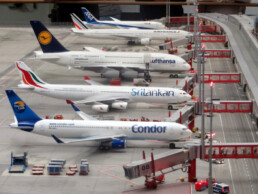
All Royal Schiphol Group's units are set to run on sustainable power from the beginning of 2018. The idea is that all the power will be generated by the new Dutch wind farms run by the energy company Eneco. In the meanwhile, wind farms will be supplied with other sustainable sources in the Netherlands.
This comes as a result of an ambitious plan launched by the Government, by which they intend to knock down greenhouse gas emissions by 2050 and, in the shorter term, aims to switch to 16 percent sustainable energy by 2023. According to Jeroen de Hass, the Eneco Group's CEO, "For the energy transition, it is crucial for the business sector to embrace sustainability".
That's why for the pioneers such as Royal Schiphol Group are consciously choosing new, sustainable ways of productoin and are therefore pave the way for others to come.
Source. https://www.cnbc.com/2017/08/15/dutch-airports-to-be-powered-by-renewable-energy-from-2018.html
A New Connection Agreement for the Dutch Offshore Wind Grid
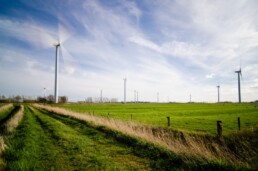
The transmission system operator for the Netherlands, Tennet, has recently signed a grid connection agreement with DONG Energy, after winning the public tender by the government for the first two areas in Borssele of 700 MW.
By signing the above-mentioned agreement with TenneT, the transmission system operation for the Netherlands, will allow for the transmission of power from the Borssele wind farm to TenneT's Borssele Alpha platform.
In this way, the full connection of an offshore wind farm is formalised to supply energy to the Dutch grid. This is considered to be the first offshore connection, which will be operational in 2019, in order for DONG Energy to deliver the wind energy through our high voltage grid to the Dutch households.

India plans greener ports driven by wind and solar power
India is determined to become one of the first countries to use renewables energy for the vast majority of its ports and dock operations, by converting all twelve of its major domesic ports to renewable energy by 2019.
The idea is to set up around 200MW of wind and solar energy, with the possibility of expanding to reach 500MW in the ycoming years. The initial capacity will include around 45MW of wind power, which will be added by the two major ports of VO Chidambaran and Kandia, which has 600 square kilometres of land. In this way, this project will undoubtedly help to reduce carbon dioxide emissions by 136.500 tonnes annualy when completed, and will also lead to savings of INR 750 million ($11,1) annually, when fully comissioned.
The cost of solar energy per unit has dropped to INR 2.63 per unit and the capital cost of wind energy has dropped too, which will help all ports to cumulatively save INR 6-7 billion ($90-110 million) annually.
Source. http://www.windpowermonthly.com/article/1438411/india-plans-greener-ports-wind-solar-power